Just Write

Just Write

martes, 15 de mayo de 2012

Symbiosis

Completing the tenth chapter of The Selfish Gene, I feel as if I could ace the Biology exam at any moment. What Dawkins has taught me fascinates me. Especially in this chapter where he describes how fungi co-exist with termites for each others' benefits, which is called symbiosis. Sure, I already knew types of symbiosis as oxpeckers (birds), eat ticks off of zebras to feed themselves and help the zebras get free of parasites. Although, I had never heard of plants and insects helping each other out for their own benefits for survival. That really impressed me. 

Putting this chapter in practice, I can see how this may benefit humans if they use reciprocal altruism. Doing a favor for another can be useful when you need it, though you can't be so sure if you'll fall into a scheming trap of a cheater and you end up as a sucker. When people ask me for favors, I nervously ask what they need hoping it won't be a huge one. I find myself to be somewhere in between a Grudger and a Sucker. looks like my genes are not selfish enough to be a Cheat. 


Vocabulary used: 

Reciprocal altruism (P. 166): Doing a favor to another, expecting to later benefit from this.

Symbiosis (P. 181): Also known as mutualism, this is the “relationship of mutual benefit between members of different species.”

Sucker (P. 184): An animal that helps another even if the other won’t help in return, “indiscriminate altruists.”

Cheat (P. 184): “Gain benefits without paying the costs.”

Grudger (P. 185): Only help those who help them in return.

lunes, 14 de mayo de 2012

Blue Eyes for You, Blonde Hair for Me


DNA: The final frontier. These are the voyages of the Deoxyribonucleic acid. Its billions year mission: To create strange new beings, to make out new life and new civilizations, to boldly go where no man has gone before.

DNA is the what holds all of the genetic material that every living thing needs in order for its species to continue roaming the Earth. Though, we still haven't cracked open all of its mysteries in order to understand the fundamentals of its core. As genes inside the DNA control everything physical and the way a species evolves, it does not mainly affect the characteristics of it, like humans. I may have gotten my dad's eye color and my mom's hair color but I didn't necessarily inherit my parents's personality or skill. "No matter how much knowledge and wisdom you acquire during your life, not one jot will be passed on to your children by genetic means. Each new generation starts from scratch."(page 23)


I remember when once in class we discussed about what we inherit from our parents genes. Many said that both physical and characteristics were inherited. I on the other hand, opposed this theory saying only physical inheritance was affected when genes are passed on. Personality, skills and characteristics are all acquired by one's experience. I doubt that being funny, knowing how to dance and kiss well were around and evolved about one million years ago when the first modern humans were evolving. It couldn't of evolved after homo sapiens were around as human evolution takes a tremendous amount of time. Even though there is still a lot of things to discover and learn of DNA, Dawkins did his best to describe what is known from chromosomes. Cells being rooms of a building and nuclei bookshelves containing architect's plans of the building, it's as if though everything is being built to create their own survival machine, a physical, emotionless, dull machine.

sábado, 12 de mayo de 2012

Are Genes that Selfish?

It's been a while since I've read a good book. Suspense, mystery, action, comedy these genres fill my shelves. School textbooks are on my desk. Now with Richard Dawkins' The Selfish Gene, it has me placing it somewhere in between. Now I'm eager to see who cracks open the famous Religion vs. Science debate in class. Though, from what was taught for almost a year now, I've learned more in just a few minutes of reading.

Richard Dawkins describes exceptionally well and interesting about the infamous subject of genes which many high-schoolers seem to avoid. "Survival of the fittest" just makes it the more exciting, seeing you can relate it to those movies or games where it's just killing and moving on to learning that penguins push their families and friends off cliffs for their own safety.

Stopping at chapter 2: The Replicator, it had many of my classmates questioning the author's, and Darwin's, reasoning over how could a mistake create perfection. "But now we must mention an important property of any copying process: it is not perfect."(page 16) There was bound to be a mistakes. If the Replicator was out there making millions of copies of itself, you wouldn't expect it to be 100% correct all the time. Not even the bible can handle writing the exact same thing hundreds of times without making mistranslations. "I suppose the scholars of the septuagint could at least be said to have started something big when they mistranslated the Hebrew word for 'young woman' into the Greek word for 'virgin', coming up with the prophecy: 'Behold a virgin shall conceive and bear a son...'"
Something can't become better without learning, or in this case adapting, from its own mistakes. Basically mistakes are what give evolution a reason: create a easier and safer life for the next generation. This is all part of Darwin's natural selection.
Therefore, genes are perfecting themselves for a better survival machine, us.

lunes, 5 de marzo de 2012

Crossing Pasts

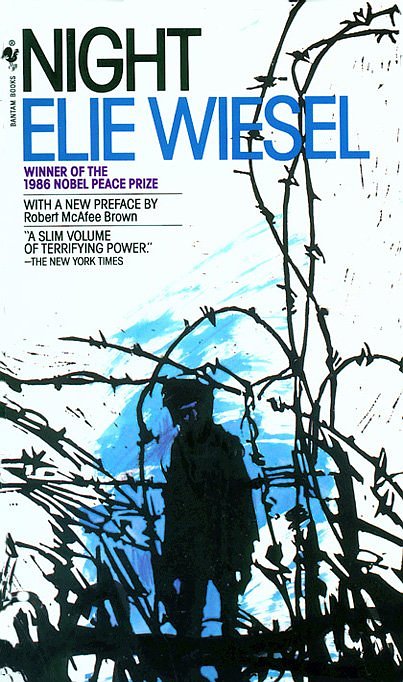
After finishing Voltaire's Candide, I couldn't help but notice that there are examples that can be related to Elie Wiesel’s Night. From the plot to the characters, there is something familiar between both novels.

The characters of both novels can be compared for their personality and their role in the book. Starting with Moshe the Beadle in Night, he in the novel started out as Elie’s mentor and philosopher, teaching him all about Judaism. His personality shows great caring for Elie and for his fellow friends of the village. Moshe the Beadle can be compared to Pangloss, Candide’s tutor, who lectured him on the ‘best of al possible worlds.’ His personality being a bit more satirical due to Voltaire’s ways shows his interest in cause and effect. Both of them have had a great influence on the main character of both novels from teaching them theories and stories to giving them advise on how to survive in the future. I could add that both of them have returned from the “dead.” Moshe the Beadle returning to the village as the only survivor of a camp and Pangloss returning after being “hanged.”

Candide and Elie share their same goals, saving their loved ones from disaster. In Night, Elie is committed to saving his family from the concentration camp in any way possible. He fights starvation, torture and desperation as he survives through the horrible experiences of the Holocaust. Candide has had nothing but bad luck. As Elie, his only priority is to marry Lady Cunégonde and escape the horrible events that are occurring in Europe. He is tortured, starved and tricked throughout his journey. At the end, their long and hard work to complete their goal and survive is unfulfilled. Despite surviving, Elie did not manage to save his family and Candide was unsatisfied with Lady Cunégonde. A bitter taste was left after going so far.


As of the plot, the constant move of the characters changed perspective and feeling to the reader. Elie’s move between camps is parallel to Candide’s voyages from continent to continent, each destination being somewhat different for the character and the reader.

Although both novels are different from each other, one being a memoir and another a satirical novel, their similarities can show that reality may not always be a happy ending. 

sábado, 25 de febrero de 2012

Tending Voltaire's Garden

Finishing Candide, I was left confused. Why would Voltaire bring back to life both Pangloss and the Baron? Also, the way he ended the novel Final chapter "Conclusion" seemed that he wanted to rush things through and get it over with. My expectations were that Candide would finally find what he was looking for without any problems but it seemed that from the beginning, the story was nothing but a misfortune.

Although the highly noticeable rushing of Voltaire to end the novel, he ends it with a simple sentence, that again must be analyzed to comprehend its very core meaning.

"'That's true enough,' said Candide; 'but we must go and work in the garden.'" (pg. 144)

Going a bit back we can see Pangloss explains what Candide means in garden. “’I also know,’ said Candide, ‘that we must go and work in the garden.’
'You are quite right,’ said Pangloss. ‘When man was placed in the Garden of Eden, he was put there “to dress it and to keep it”, to work, in fact; which proves that man was not born to an easy life.’” (pg 143)
I find it interesting that pangloss, after having a much distant theory of life with everything is for the best and everything is made for an apparent reason, he suddenly believes in the Bible's theory of life. Another thing that makes me question what was going on in Voltaire's head as he wrote these final pages. 

Though my interpretation of the last sentence of Candide is that each garden is different to every person. Some work hard on it and some don't. Some have more in it and others less. Thus the garden is someone's life. Candide states that everything that has happened before may had an impact on the present but what lies on the future, lies on what one wants to gain from it. Of course, Voltaire's garden is figuratively and is far away from being the same as the garden in the Bible. 

Finally, this book was interesting to read. Never have I read satirical books, essays or poems in my life and was both confusing, irritating and funny when it came to understanding but the only words I am left are: Why Voltaire, why?  

domingo, 19 de febrero de 2012

Utopia in a Dystopia?

Candide's and Cacambo's journey has made a turn of the best. After all the torturous path they had taken from Paraguay, escaping the barbaric Oreillons they had found hope. “They had a rough idea which direction to take, but they found formidable obstacles everywhere in the shape of mountains, rivers, precipices, brigands, and savages.” (pg. 73).

ad found themselves in Eldorado which had blown theirs minds on the way the people lived and prospered. “’What Country can this be?’ said one to the other. ‘It must be unknown to the rest of the world, because everything is so different from what we are used to. It is probably the country where all goes well: for there must obviously be some such place. And whatever professor Pangloss might say, I often noticed that all went badly in all Westphalia.’” (pg. 77). They both had wandered into this utopia without recognizing it. Somehow their luck had just changed. As they explore this unknown territory they are surprised to learn of how peaceful it is with no disputes what-so-ever.

Their reactions must be represented as those from the early colonization time period. They are baffled as they see ordinary children playing with gold and jewels and how they are interpreted as their useless rocks. Something so regular for some can be such a treasure to others. Just like the spaniards with the Incas' gold.

What makes this a utopia is not the gold and jewels that is surrounding the whole city but the culture. I can remember in one of my first english class of the semester, I had to create a utopia. In my utopia I wrote that it must include rights for everyone, equality, freedom of speech and no disputes between people. Eldorado basically described a utopia that included most of the ideas I had for mine. It is a utopia inside a dystopia. It is funny how the it has not yet fallen into the misfortune of corruption as the rest of the world has.

I am eager to know what will happen to both our protagonists while they stay in "paradise".

viernes, 17 de febrero de 2012

Discovering the Unknown


Candide and Cacambo, after escaping from the Jesuit Paraguay, entered Oreillons territory in which was a completely strange and new place for both of them. They barley survived the barbaric Oreillons trying to, by the looks of it, eat them as a punishment for murdering their lovers, monkeys, and for believing that they were Jesuits. "They were encompassed by fifty naked Oreillons, armed with bows and arrows, with clubs and flint hatchets. Some were making a large cauldron boil, others were preparing spits, and all cried: "A Jesuit! a Jesuit! we shall be revenged, we shall have excellent cheer, let us eat the Jesuit, let us eat him up!"" (pg. 70) Showing the Oreillons that they weren’t Jesuits and that they had killed the Colonel saved them. They were set free.

It is interesting how Voltaire describes the New World as being savage and barbaric. It’s a wilderness filled with uncivilized indigenous tribes trying to eat Jesuits. The very first stories about the New World were some years after Christopher Columbus discovered it in 1492. These stories contained experiences of people when they were exploring for gold. Some were against the indigenous tribes, exaggerating the things that they did and how their culture was. Some, mainly missionaries, wrote stories that explained and inspired their diverse culture. The exaggeration of these stories triggered the thought of the New World, by the Europeans, to be a dangerous and uncivilized place. I have no information of Voltaire ever visiting America and experiencing what he describes in Candide. He might have passed on the stories he heard or read of the New World and incorporated them into the novel.

From suffering near death experiences, Candide and Cacambo move on to find help and return to Lady Cunégonde.  Will they experience any more savage tribes? Will they get lost in the rainforest? From what Candide has experienced and from what Voltaire has given the audience, these are possibilities of what Candide’s destiny holds.